
Living in Australia means skin cancer is a topic that hits close to home for almost everyone. We are colloquially known as the “skin cancer capital of the world,” and recent data suggests that 69% of Australians will develop at least one keratinocyte cancer – ie a basal cell (BCC) or squamous cell carcinoma (SCC) – in their lifetime. For many patients, the management of sun damage feels like a repetitive cycle of “spot-treating” individual lesions as they appear.
However, a significant shift is occurring in clinical dermatology. We are moving from purely aesthetic rejuvenation to biological risk modification. Emerging research shows that the fractional lasers we’ve long used to treat wrinkles and scars are actually capable of modifying the “soil” of sun-damaged skin to stop cancer before it starts
Modifying the “Soil,” Not Just the Spots
Most of us think of sun damage as the individual spots we can see. In reality, these are just markers of a broader problem called field cancerization. Chronically sun-damaged skin behaves differently at a molecular level; it contains “senescent” or “sleeping” cells that fail to protect the skin from UV radiation.
There is a growing body of scientific evidence to show that fractional resurfacing lasers have a tri-modal effect on field cancerization – they work in 3 different ways. Firstly, they physically remove damaged skin cells with UV-induced DNA mutations, preventing them from replicating and essentially clearing the board to make room for younger, healthier cells to enter.
The second mechanism is one of the most exciting breakthroughs in this field, and involves a hormone called Insulin-like Growth Factor-1 (IGF-1). In healthy young skin, IGF-1 acts like a repair engine, telling your skin cells how to fix DNA damage after sun exposure. As we age – and particularly in Australian skin with high cumulative UV exposure – this engine often stalls. Fractional lasers essentially “restart” this repair engine by recruiting fresh, active cells that restore IGF-1 levels to a state indistinguishable from young skin.
The third part of the story is the way that the immune system responds as it heals the area of skin treated with the laser: the mutated cells that are vaporized with the laser don’t just vanish into thin air – their cellular debris remains and needs to be cleaned up by our immune system. This process triggers a response similar to a vaccination: the immune system learns at a cellular level to recognise the signals that the damaged skin cells were carrying so that recognises & destroys them if it meets them again. So we can teach the cells of our immune system to be better at fighting sun damage in the future.
The Evidence: More Than Just a Glow
The clinical results supporting this “proactive” approach are compelling. There are two primary types of fractional lasers used for this purpose:
Ablative Fractional Lasers (like CO₂): These lasers physically remove microscopic columns of tissue, directly extruding DNA-damaged cells that harbour dangerous mutations. Studies have shown that a single session can reduce precancerous actinic keratoses (AKs) by 60–75%, with some patients seeing these protective benefits last for over five and a half years.
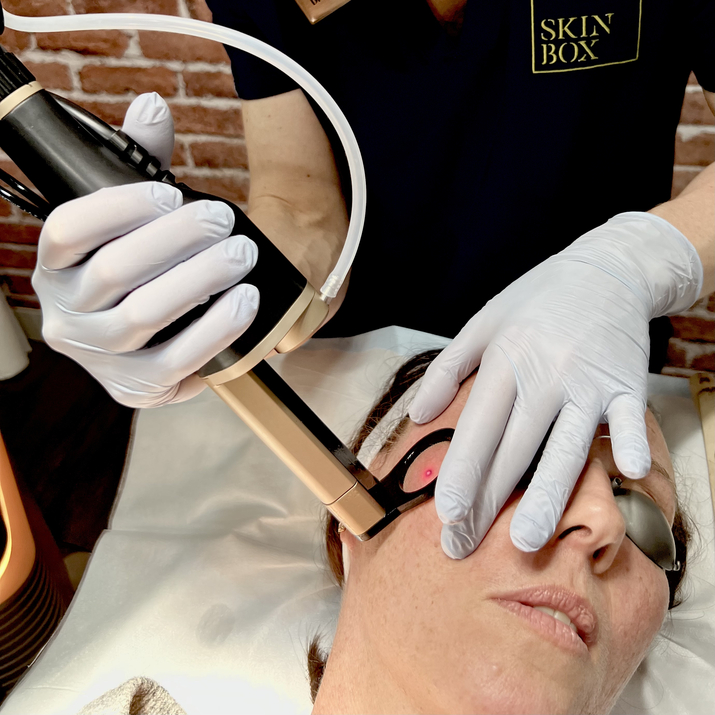
Non-Ablative Fractional Lasers (Erbium): For those seeking a lower-downtime option, these lasers still offer significant protection. A major retrospective study found that patients treated with non-ablative fractional lasers had a 50% lower risk of developing subsequent facial skin cancers compared to those who didn’t receive the treatment.
At SkinBox we use an Alma Hybrid laser device, which can emit either / both of the above wavelengths – so we can custom design a treatment for each individual skin.
A Proactive Future for Your Skin
It is important to remember that while fractional resurfacing is a powerful tool for risk modification, it is not a replacement for daily sun protection, professional skin checks, or established medical therapies.
Instead, we view this technology as a way to change the biological trajectory of your skin. By treating the entire “field” of sun damage rather than just reacting to new cancers as they arise, we can help restore your skin’s natural resilience. If you have a history of multiple skin cancers or significant sun damage, now is the time to move beyond simple rejuvenation and discuss a personalized risk-modification plan.
To learn more about whether fractional resurfacing is right for your skin health journey, book a consultation with one of our clinical team of Dermal Therapists today.
REFERENCES
Andrade MJ, Satyamoorthy K, Upton Z, Van Lonkhuyzen DR. Insulin-like growth factor-I rescue of primary keratinocytes from pre- and post-ultraviolet B radiation effects. J Photochem Photobiol B. 2020;209:111951. doi:10.1016/j.jphotobiol.2020.111951
Benson TA, Hibler BP, Kotliar D, Avram M. Nonablative Fractional Laser Treatment Is Associated With a Decreased Risk of Subsequent Facial Keratinocyte Carcinoma Development. Dermatol Surg. 2023;49(2):149-154. doi:10.1097/DSS.0000000000003672
Chen R, Wargo JJ, Williams A, et al. Single Ablative Fractional Resurfacing Laser Treatment For Forearm Actinic Keratoses: 6-Month Follow-Up Data From An Intrapatient Comparison Between Treated and Untreated Sites. Lasers Surg Med. 2020;52(1):84-87. doi:10.1002/lsm.23175
Erlendsson, A. M., Olesen, U. H., Haedersdal, M., & Rossi, A. M. (2020). Ablative fractional laser-assisted treatments for keratinocyte carcinomas and its precursors-Clinical review and future perspectives. Advanced drug delivery reviews, 153, 185–194. https://doi.org/10.1016/j.addr.2020.01.001
Kawakubo M, Cunningham TJ, Demehri S, Manstein D. Fractional Laser Releases Tumor-Associated Antigens in Poorly Immunogenic Tumor and Induces Systemic Immunity. Sci Rep. 2017;7(1):12751. Published 2017 Oct 6. doi:10.1038/s41598-017-13095-8
Olsen CM, Pandeya N, Green AC, Ragaini BS, Venn AJ, Whiteman DC. Keratinocyte cancer incidence in Australia: a review of population-based incidence trends and estimates of lifetime risk. Public Health Res Pract. 2022;32(1):3212203. Published 2022 Mar 10. doi:10.17061/phrp3212203
Razzaghi Z, Arjmand B, Rezaei Tavirani M, Hamzeloo-Moghadam M, Rostami Nejad M, Robati RM. Long and Short-terms Effects of Ablative Fractional Laser Therapy on Human Skin: A Network Analysis. J Lasers Med Sci. 2023;14:e27. Published 2023 Aug 27. doi:10.34172/jlms.2023.27
Spandau DF, Chen R, Wargo JJ, et al. Randomized controlled trial of fractionated laser resurfacing on aged skin as prophylaxis against actinic neoplasia. J Clin Invest. 2021;131(19):e150972. doi:10.1172/JCI150972
Trovato E, Fiorani D, Cartocci A, Cinotti E, Rubegni P (2023) IGF1 synthesis after CO(2) fractional laser resurfacing (FLR): new insights in the treatment of scalp actinic keratoses. Lasers Surg Med 55(7):642–652
Wenande, E., Wanner, M., Sakamoto, F.H. et al. The evolving landscape of laser-based skin cancer prevention.Lasers Med Sci 40, 70 (2025). https://doi.org/10.1007/s10103-025-04327-9